

Curtain Fabric Weight GSM Guide: A Must-Read for B2B Buyers

Fabric weight, measured in grams per square meter (GSM), is the fastest single number for comparing two curtain fabrics - provided both suppliers are quoting the same thing. That "provided" does a lot of work: the weight that matters is the total of the fabric stack (face, lamination, coating), not just the face cloth. Buyers who compare face-fabric weights only are comparing different products without knowing it.
Key takeaways
- Compare total fabric weight (face + lamination + coating), never face fabric alone; a quote based on face fabric only understates the real product.
- The standard industry tolerance on curtain fabric weight is ±5% - a 200 g/m² fabric may legitimately weigh 190-210 g/m².
- Sunscreen fabric at 5% openness typically runs 400-450 g/m² on a polyester base and 450-540 g/m² on fiberglass; the PVC coating alone is roughly 65-75% of total weight.
Why GSM decides so much
Weight is a proxy for several properties buyers care about, which is why it appears in almost every sourcing conversation:
- Hand feel and drape of the finished product
- Blackout rate and thermal insulation
- Durability and tear resistance
- Ex-factory price - higher weight means higher material cost
- Packaging volume and shipping efficiency
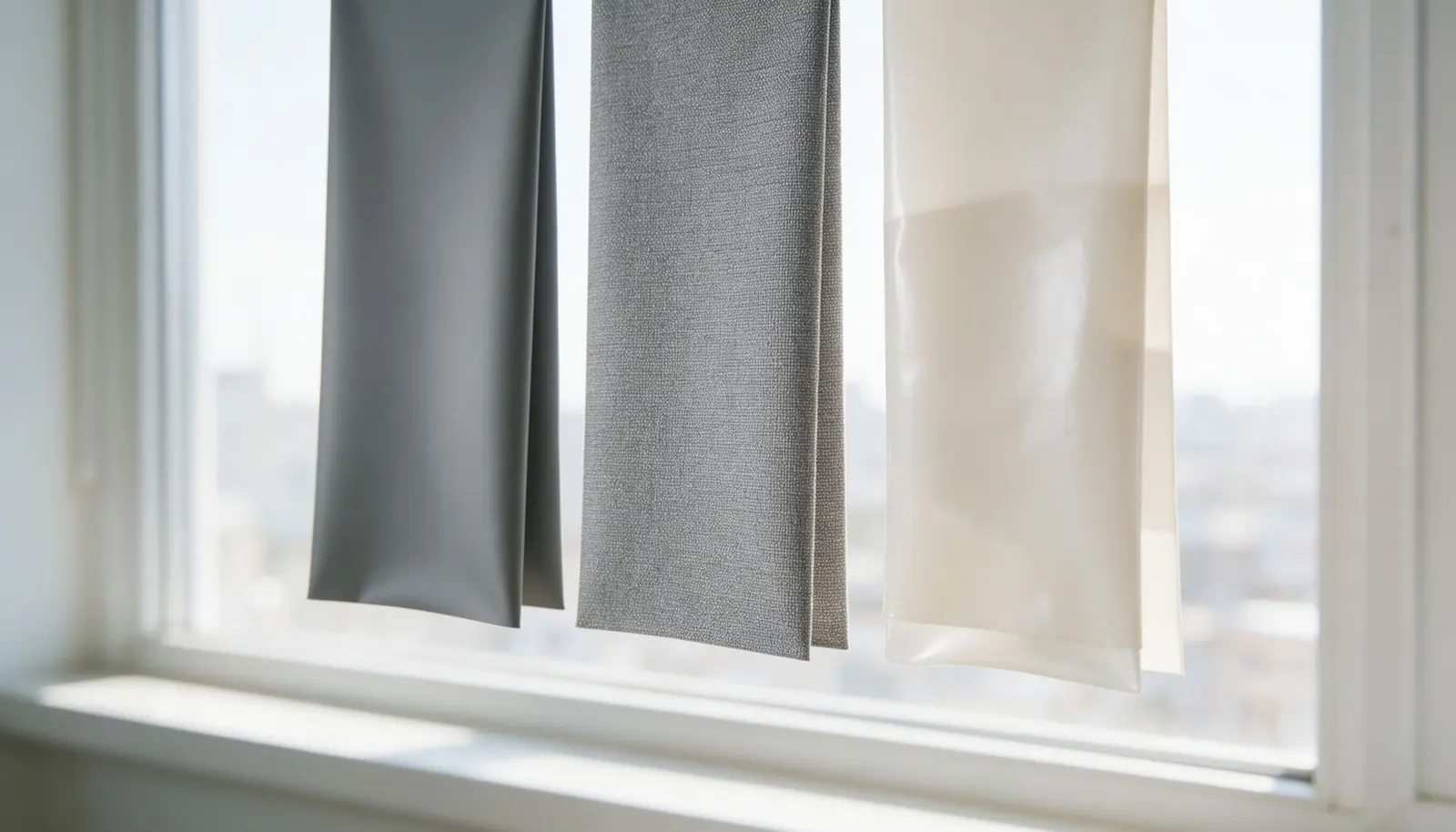
Weight is a stack, not a single layer
Curtain fabric weight is the total weight of a multi-layer structure, and each layer moves the number differently:
| Layer | Description | Weight impact |
|---|---|---|
| Face fabric | Visible woven fabric; decides appearance and hand feel | Main component |
| Lamination layer | TPU film, aluminum foil, etc., for blackout or insulation | Moderate |
| Coating | Acrylic, PVC or foam coating for blackout or water resistance | Significant |
Confirm the total weight with the supplier, including lamination and coating. Different suppliers quoting only face fabric weight is the most common cause of inconsistent comparisons.
The ±5% industry tolerance
The standard industry tolerance for curtain fabric weight is ±5%. In practice that means a fabric rated at 200 g/m² is acceptable between 190 and 210 g/m². The spread comes from yarn tension and coating thickness variation during manufacturing, so a purchase contract should state the tolerance range and what happens outside it.
Typical weight ranges by product type
| Product type | Typical range (g/m²) | Notes |
|---|---|---|
| Zebra blinds | 120-200 | Sheer sections lighter, opaque sections heavier; average overall |
| Roller - sheer / semi-blackout | 150-250 | Depends on coating thickness and fabric density |
| Roller - blackout | 250-400 | Three-pass blackout or foam coating weighs more |
| Honeycomb shades | 200-350 | Cellular structure needs stiffness; blackout versions add an aluminum foil layer |
| Pleated blinds | 150-250 | Pleating requires thickness and thermoplasticity |
| Sunscreen fabric | See the section below - weight there follows openness and base material | |
Sunscreen fabric: weight driven by openness and base
Sunscreen fabric behaves differently because its weight is set mainly by the openness factor, the base material (fiberglass or polyester) and the PVC coating thickness.
Typical weight by openness factor:
| Openness | Typical range (g/m²) | Notes |
|---|---|---|
| 5% (most common) | 400-450 | Market mainstream; common specs are 400/420/430/450 GSM |
| 3% | 450-750 | Lower openness = denser yarn = higher weight |
| 0% (blackout sunscreen) | 420-530 | Zero openness; light blocking comes from the PVC coating |
| 10% and above | Relatively lighter | Larger openings = lower weight |
By base material:
| Base material | Weight characteristics | Performance difference |
|---|---|---|
| Fiberglass + PVC | Higher weight; 5% openness commonly 450-540 GSM | Better dimensional stability, fire resistance and durability |
| Polyester + PVC | Wider range; 5% openness commonly 305-520 GSM | More flexible, lower cost, more choices |
For reference, our sunscreen roller (YH551SC) is built on a 30% polyester + 70% PVC composition - the PVC share is what carries the weight, and it is what changes when you move between openness factors.
Sunscreen fabric composition:
- PVC coating typically accounts for 65-75% of total weight
- Base material (fiberglass or polyester) accounts for 25-35%
- Total weight = base material + PVC coating; tolerance typically ±5%
Weight versus performance
| Performance | Higher weight | Lower weight |
|---|---|---|
| Blackout rate | Usually higher (thicker coating) | Usually lower |
| Thermal insulation | Usually better | Usually weaker |
| Durability | More wear and tear resistant | Easier to wear |
| Hand feel | Thicker, stiffer | Lighter, softer |
| Price | Higher material cost | Lower material cost |
| Packaging volume | Relatively larger | Relatively smaller |
Weight is not the sole quality indicator. Fabrics of the same weight can perform differently depending on the weaving process, coating type and yarn quality, so use GSM as the first filter, not the final verdict.
How to buy against GSM
- Ask suppliers for total weight test reports, with the test method stated.
- Confirm what the quoted weight includes - coating and lamination or face fabric only - before comparing quotes.
- Put the tolerance range (usually ±5%) in the contract, with a remedy for out-of-tolerance goods.
- Keep golden samples and compare bulk goods against them for weight and hand feel.
- Judge on more than weight: color fastness, tear strength and coating adhesion matter just as much.
If blackout construction is your next question, our blackout fabric process comparison explains coated, woven and laminated options, and our opacity guide positions the three fabric families.