

Pleated Blind Pleats: Pleat Factor, Fabric Consumption & Quality for B2B

The single number that drives pleated blind costing is the pleat factor. A pleated blind uses roughly 1.3 times its finished height in fabric, which means a quote priced on finished dimensions alone is quietly losing money. For B2B buyers this guide covers how the factor works, how to calculate fabric consumption, how to choose pleat size, and how to read pleating quality during inspection. We build cordless and easyfix tensioned pleated blinds on 100% polyester, and the same numbers below are the ones we expect our buyers to check.
Key takeaways
- The standard pleat factor is about 1.3 (industry range 1.2-1.5): 1 meter of finished height needs about 1.3 meters of expanded fabric.
- A 120x200 cm blind consumes about 3.12 m² before allowance, or about 3.28 m² with a 5% edge and cutting allowance; across 500 units that is about 1,640 m².
- Inspect pleats three ways: straightness, even spacing within plus/minus 1 mm, and resilience (a good pleat re-flattens within 1 second after being held open for 3 seconds).
- Heat-set pleating on 100% polyester is the reliable process; mechanical pleating looks similar but shallow over time.
What a pleat actually is
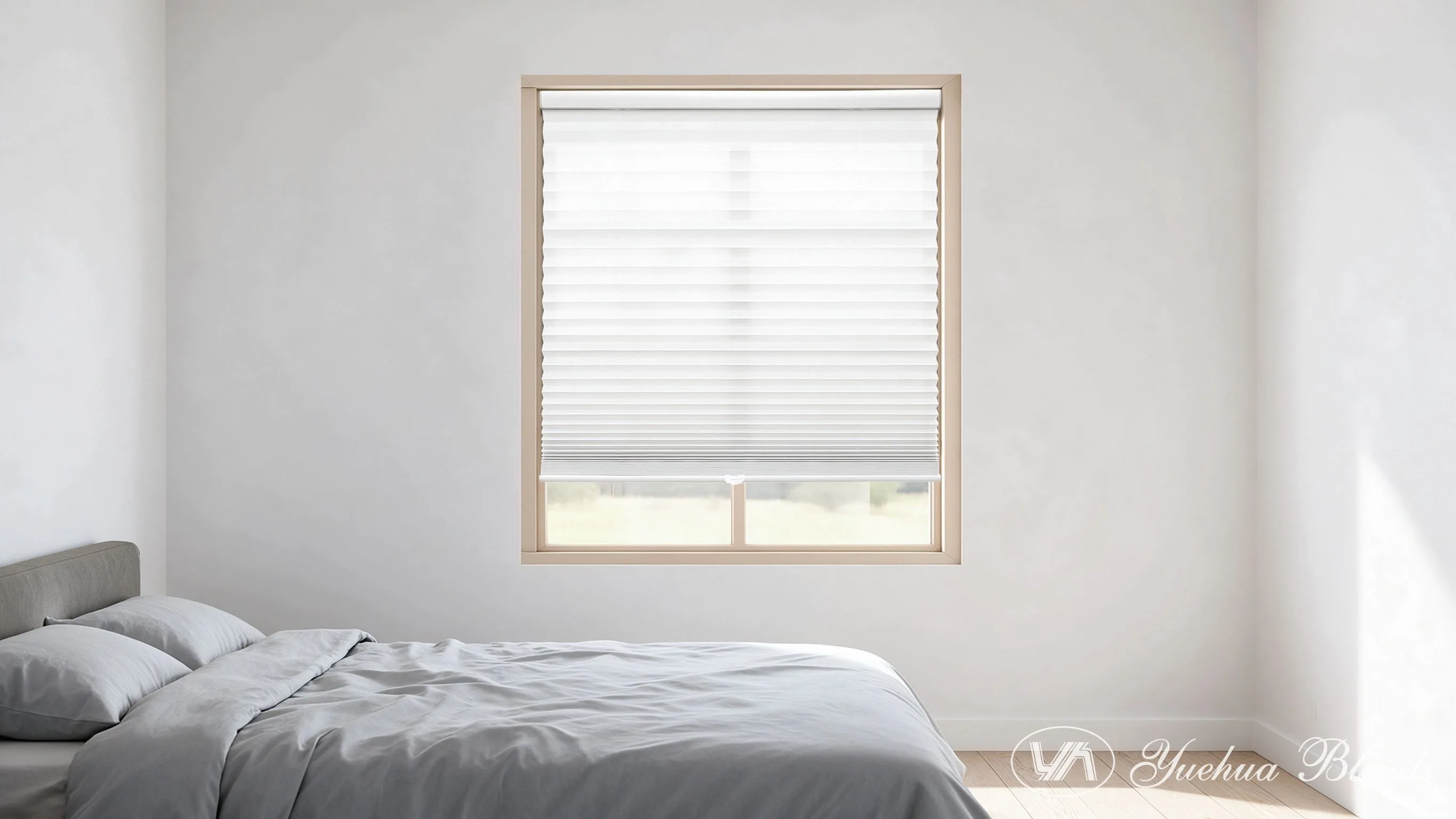
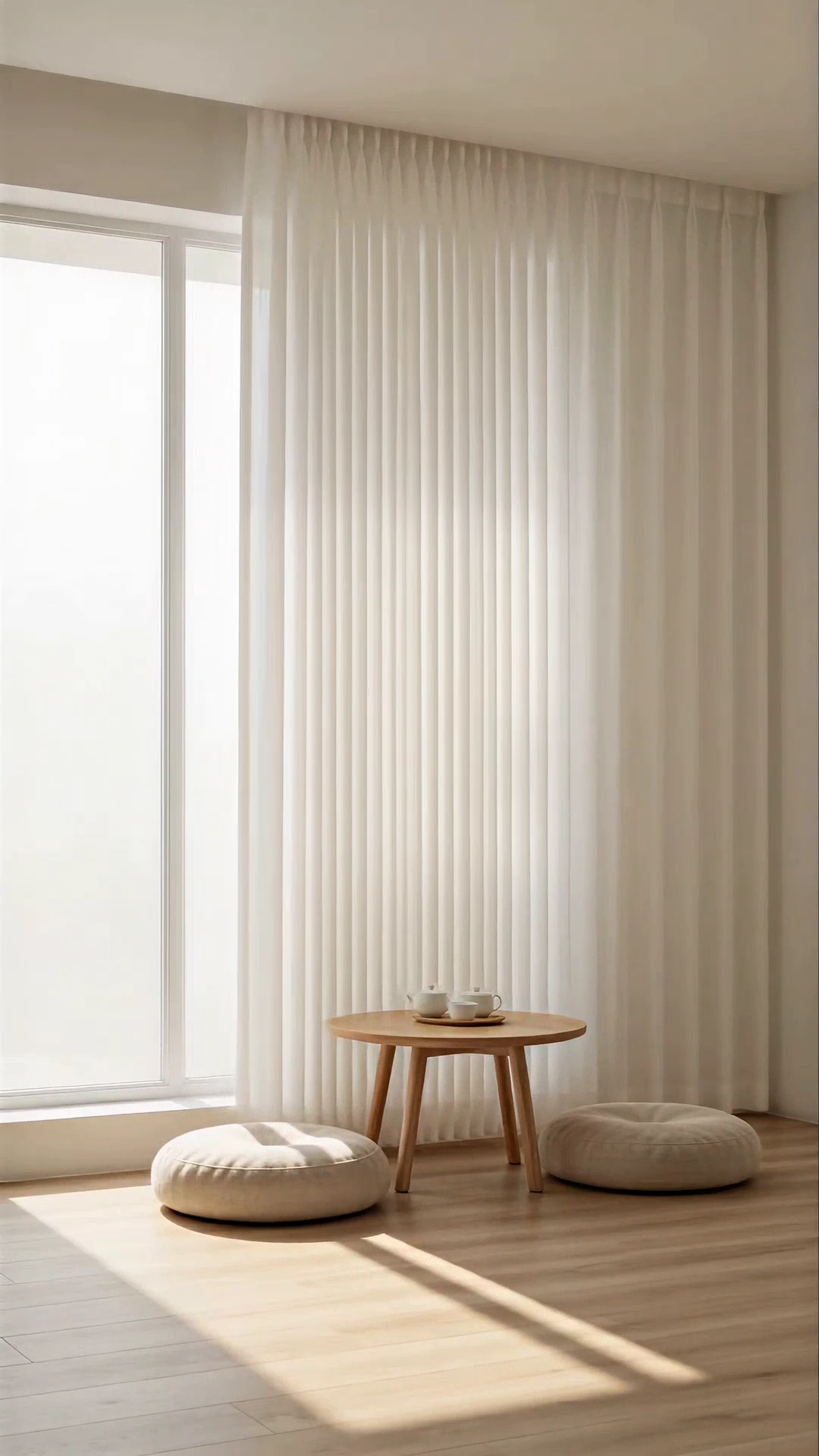
A pleated blind (plisse) is defined by permanent accordion pleats. These are not simple folds; they are creases set into the fabric by pleating equipment under heat and pressure. Pleats do three things: they let the blind stack flat when raised and open into a full surface when lowered, they stay set in normal use, and they form a thin air layer. That air layer gives limited insulation, far below the closed cell of a honeycomb shade.
Pleat factor and fabric consumption
Pleat factor (or fabric multiplier) is the ratio of expanded fabric length to finished blind height. The standard is about 1.3, so 1 meter of finished height uses 1.3 meters of fabric, and a 200 cm tall blind consumes 260 cm in the height direction. It is not fixed; the industry range runs 1.2 to 1.5 depending on pleat density, fabric thickness and maker design.
It matters because fabric is the single largest cost in a blind. A 0.1 error in pleat factor on a large order can mean thousands of dollars of wasted fabric or an underquote. It also lets you test whether a cheaper supplier is really cheaper, or just using thinner fabric and lower pleat density.
The calculation is:
Fabric consumption (m²) = finished width (m) x finished height (m) x pleat factor + allowance.
Finished width and height are the installed dimensions. Pleat factor is 1.3 standard, or the supplier-confirmed value. Allowance covers edge wrapping, top and bottom rail attachment and cutting waste, typically 3-5% of total area.
Worked example. A 120 cm wide x 200 cm high blind at factor 1.3: 1.20 x 2.00 x 1.3 = 3.12 m², plus about 5% allowance = 3.28 m² per blind. Across 500 units that is 1,640 m². A 0.1 error (1.2 versus 1.3) is a 120 m² difference on the order.
Choosing pleat size
Common pleat sizes and where they fit:
| Pleat size | Visual effect | Typical use |
|---|---|---|
| 20 mm | Fine and delicate, strong pleat presence | Small windows, bathrooms, kitchens; refined appearance |
| 25 mm | Balanced and versatile, most common | Living rooms, bedrooms, offices; most standard uses |
| 32 mm | Clean and spacious, open pleats | Large and floor-to-ceiling windows, public spaces |
Dense pleats (small size, high density) look finer, use slightly more fabric and stack lower when raised. Open pleats (large size, low density) look cleaner, use slightly less fabric and stack higher. Pleat size also sets stack height: roughly 20 mm of stack per meter of finished height for 20 mm pleats, 20-25 mm for 25 mm, and 25-30 mm for 32 mm. For inside-mounts with limited frame depth, calculate stack height before ordering.
Heat-set versus mechanical pleating
Pleating quality depends on how the crease is set.
| Process | Principle | Setting quality | Best fabrics |
|---|---|---|---|
| Heat-set | Fabric is heated past its glass transition temperature and set as it cools | Firm set, good retention, durable | 100% polyester and other thermoplastics |
| Mechanical pleating | Pleats pressed mechanically with no heat setting | Weaker set; pleats may shallow over time | Blended or heat-sensitive fabrics |
Heat-set is the mainstream process and sets far better than mechanical pleating. It relies on three controls: temperature high enough to rearrange the fiber, pressure tight enough to give clean creases, and hold time long enough to complete setting. 100% polyester takes heat-set best; blends are harder to set and need tighter temperature and time control. Weakness in any of the three is the usual root cause of pleats that unfold after months of use.
Inspecting pleats: straightness, evenness, resilience
Pleat factor tells you consumption; pleating quality tells you appearance and service life. Check it three ways.
Straightness. Lower the blind fully and look from the side against light. Pleat lines should run as straight as a ruler. S-shaped bends or local skew point to inaccurate pleating equipment or uneven fabric feeding.
Evenness. Pleat spacing should be uniform. Measure at several points with a ruler, keeping deviation within plus/minus 1 mm, and check that both ends near the top and bottom rails match the middle.
Resilience. This is the test most buyers skip. Gently open and smooth a section of pleats, hold for 3 seconds, then release. A good pleat restores within 1 second with no residual crease. Repeat the fold-and-open ten times in the same spot; quality product should not show shallow or unfolding pleats. Weak-set product looks fine on day one but flattens after months, which is a top customer complaint and cannot be repaired after the fact.
Pleats versus performance
Pleats themselves do not block light; that comes from the fabric. But neat pleats edge-fit better when lowered, reducing side leakage, and denser pleats overlap a little more. The air layer between pleats is open, so insulation is limited; if insulation is the goal, a honeycomb shade is the better choice.
Pleated fabric can also be finished. A water-repellent coating makes droplets bead and roll off, useful in bathrooms and kitchens. An aluminum foil layer laminated to the back reflects light and heat and improves blackout, but adds thickness and cost. Both finishes thicken the fabric, which makes pleating harder; on thick finishes, clean straight firmly-set pleats are the clearest signal of a capable factory. Confirm the pleat factor of finished fabrics separately, as it can differ from standard cloth.
Common costing and inspection pitfalls
- Using finished area instead of expanded fabric area. A 120x200 cm blind does not use 2.4 m²; it uses about 3.12 m² (x1.3).
- Forgetting the allowance. Skipping edge wrap and cutting waste causes fabric shortages mid-production.
- Assuming one universal factor. Suppliers, product lines and fabrics all move the number.
- Ignoring roll width. Fabric comes in standard roll widths such as 200, 280 and 300 cm; blinds wider than the roll need splicing, which adds waste and cost.
- Forgetting pattern repeat. Printed fabrics need pattern matching across cuts, which adds fabric per unit.
- Not measuring the actual factor. Straighten a finished blind, measure the expanded length, divide by finished height, and compare with the committed value.
- Only checking appearance, never resilience. Weak-set pleats pass a visual check and fail months later.
- Confusing pleating processes. Mechanical and heat-set differ widely in price and quality.
Sourcing recommendations
Ask each supplier for the exact pleat factor per product and keep your own reference table. Price every custom order on expanded consumption, not finished size, and verify a sample by straightening and measuring it. Specify heat-set pleating in the contract; mechanical product is cheaper but not suitable for B2B bulk. At inspection, straighten a sample and calculate the real factor, and treat any deviation beyond plus/minus 0.05 as a supplier explanation. Run the three-way pleat check, and reject any weak-set batch, because it cannot be fixed later. Choose pleat size against frame depth for inside mounts: 32 mm open pleats for large windows, 20 mm dense pleats for small or refined ones.
One side note on roman shades: flat romans use fabric length equal to finished height plus about 10-15 cm of hemming and header allowance, with no multiplier; hobbled or relaxed romans hold soft folds even when lowered and need extra fabric by design, with no universal factor. Confirm roman consumption separately.
Bottom line
Cost every pleated blind as finished area times about 1.3 plus allowance, buy heat-set 100% polyester, and let the resilience test tell you whether a factory is serious. On the same 100% polyester basis, our fabric weight GSM guide explains how to compare the stack weight, and the cordless pleated blinds and easyfix tensioned pleated blinds pages show the two lines we build to these specs.