



Blind Quality Control: From Sample Approval to Container Loading
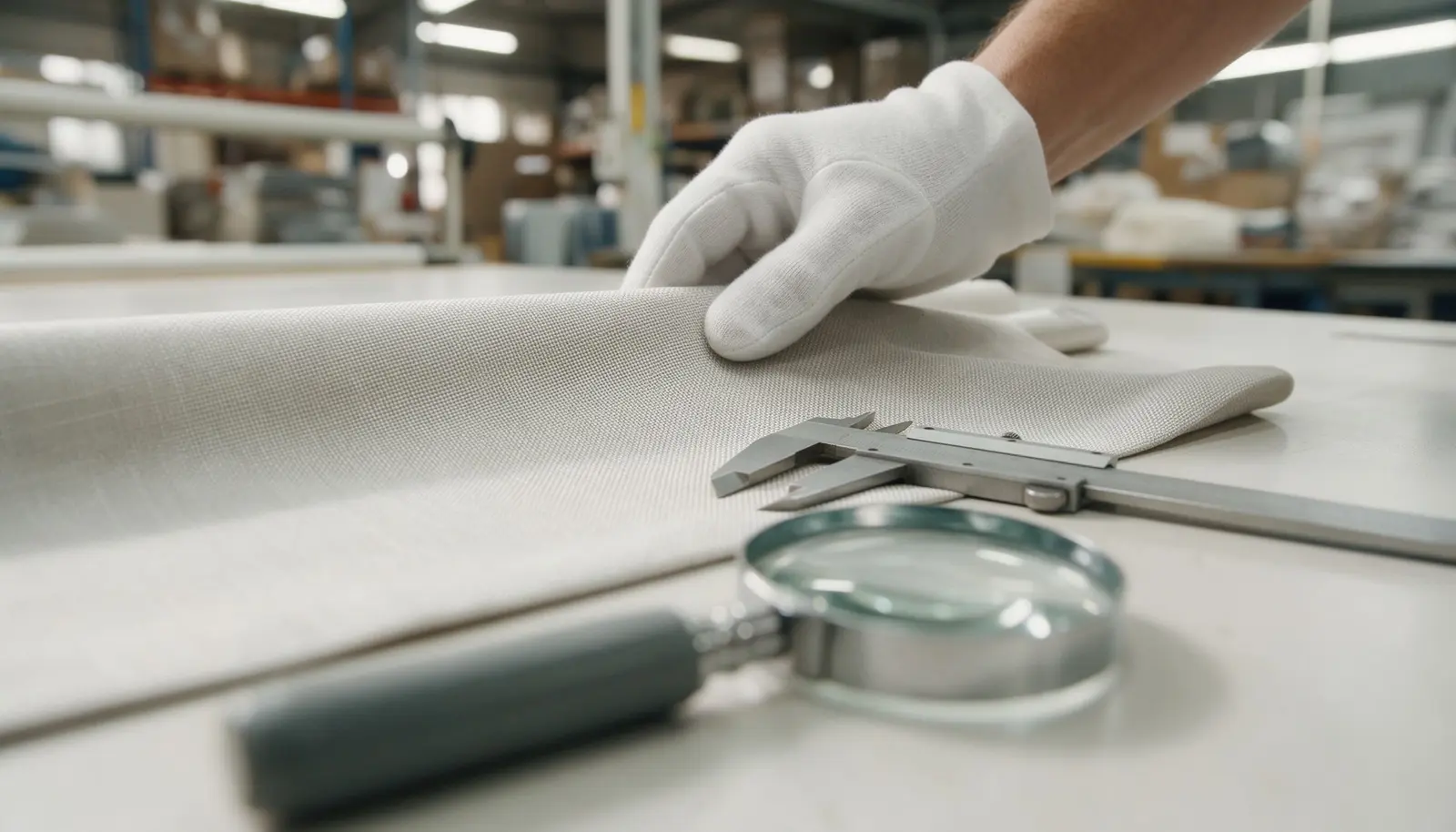
Quality in blind manufacturing is decided at the sample stage, not rescued at the container door. The reference point is a sealed golden sample that both sides keep, and every later check compares production against it. We run this as a BSCI-audited factory supplying since 1998, and the orders that avoid disputes are the ones where the sample, the inspection standard and the loading records were all agreed before production started.
Key takeaways
- The approved sample becomes the golden sample. Both parties keep a sealed copy, and any deviation from it is grounds for rejection.
- Incoming fabric is checked for weight with a standard plus/minus 5% tolerance; for blackout cloth the total weight (face fabric plus coating) is verified, not the face alone.
- The pre-shipment inspection samples statistically, typically to AQL 2.5, and compares each unit side-by-side with the golden sample.
- We provide loading photos of the empty container, the loading in progress and the sealed container with the seal number visible.
Sample approval sets the benchmark
Every bulk order starts with a pre-production sample built from the exact fabric, components and construction of the order. You approve it, and changes made now are free; changes made after production start are not. Once approved, both sides retain a sealed golden sample. Every unit in production must match it in color, fabric weight, construction, dimensions and finish. In international trade the golden sample is the practical reference for acceptance, and a deviation from it is a rejection point.
Incoming material inspection
Before production, materials are checked on arrival. Fabric rolls are inspected for color consistency, weaving defects, stains and fabric weight, with a tolerance of plus/minus 5% considered standard. For blackout fabrics, the total weight of face fabric plus coating is verified. Brackets, chains, tubes and bottom rails are checked for dimensional accuracy, surface finish and function. Cartons, polybags and hang tags are checked against approved specs. Anything off-spec is rejected before it reaches the line.
Control on the production line
Our QC team checks key stations during manufacture. Cutting: fabric is cut to size with straight, clean edges; for honeycomb shades the edge cut is critical, and pleat creases must be pressed straight and tight. Assembly: chain length, tube alignment and bracket fit are verified. Function: each unit runs through its full motion to confirm smooth operation, correct stopping and tension. Visual: every unit is checked for surface defects, stains, scratches and alignment.
We do not routinely send production photos during manufacturing. That is not standard practice and it disrupts the line. The effective control is an experienced supplier with internal QC, plus the pre-shipment inspection below.
Pre-shipment inspection
This is the final checkpoint, run after production and before packing into export cartons. A statistically significant sample is taken from the batch, typically following AQL 2.5. Each sampled unit is compared side-by-side with the golden sample for color, fabric, construction, dimensions and finish, then operated to confirm function, and its packaging, carton marks and unit count are checked against the packing list.
For very large or custom-fabric orders you can hire a third-party firm such as SGS or Intertek for an independent pre-shipment inspection. A mid-production in-line inspection is also available but is less common and adds cost and coordination.
Container loading supervision
When goods are ready we supervise loading. Carton count is verified against the packing list and commercial invoice. The container itself is checked for cleanliness, dryness and structural integrity before loading. Cartons are loaded systematically to maximize space and reduce transit damage, with heavy cartons low and light ones on top. After loading, the container gets a customs seal and the seal number is recorded.
We provide loading photos: the empty container, loading in progress, and the sealed container with the seal number visible.
Documents after sailing
Once the container sails you receive the full set: a telex-release Bill of Lading (a B/L copy lets you clear customs without the original paper document), an itemized Commercial Invoice, a detailed Packing List, and a Certificate of Origin where customs or preferential tariffs require it. All are checked for accuracy before release.
What you can do to protect quality
- Approve the sample carefully. It is your benchmark.
- Give clear specs. Vague specs cause quality issues; be specific on fabric, color, dimensions, components and packaging.
- Speak early. Raise concerns before production starts.
- Use third-party inspection for large orders when the value justifies it.
- Work with a reliable supplier. Internal QC reduces the need for costly independent checks.
Bottom line
Quality is engineered through the golden sample, incoming checks, in-line control and an AQL 2.5 pre-shipment inspection, then locked down with supervised loading and clean documents. For the commercial sequence around this, our bulk ordering guide covers deposit to documents, and our blackout fabric process comparison explains why total fabric weight matters at incoming inspection. A line where edge cutting and pleat control matter especially is the honeycomb shade range.