


EU Window Blinds Compliance Guide: CE Marking, REACH & Safety Standards

Window blinds are one of the more manageable product categories when it comes to EU compliance, provided you know which rules are actually mandatory and who carries them. In practice the split is clean: the importer in the EU takes the market-entry paperwork (GPSR responsible person, CE where it applies, declarations), while the factory supplying the blinds must deliver products that meet REACH chemical limits and EN 13120 cord safety. Manual blinds are outside the Radio Equipment Directive entirely, and flame-retardant testing is not required for ordinary residential retail.
Key takeaways for an EU order
- Manual window blinds are generally not subject to mandatory CE marking. Motorized and remote-controlled blinds must comply with RED and LVD and carry the CE mark.
- Since 13 December 2024 the General Product Safety Regulation (GPSR) requires an EU-based Responsible Person for every consumer product, including blinds. That obligation sits with the importer, not the factory.
- REACH applies at the fabric level: azo dye aromatic amines are limited to 30 mg/kg and phthalates (DEHP, DBP, BBP) to 0.1% in relevant products. Ask the supplier for test reports instead of accepting a general statement.
- EN 13120 caps free-hanging cords at 20 cm unless a safety device is fitted. Cordless designs sidestep the cord argument entirely, which is why they now dominate children's-room ranges.
CE marking: which directives actually touch blinds
The CE mark is a market-access passport, but it is not required for every blind. Three regimes matter, and only one of them reaches manual products.
Construction Products Regulation (CPR). If blinds are sold as construction components for project contracts, they need a Declaration of Performance (DoP) and CE marking. Retail blinds for normal homes generally fall outside mandatory CPR.
General Product Safety Regulation (GPSR). Since 13 December 2024 this replaced the old GPSD. Every consumer product must be safe, traceable and backed by an EU-based Responsible Person named on the product. For a blind factory in China this is simply not something we can carry - the importer must.
Radio Equipment Directive (RED). Only motorized blinds with motors or remote controls come in. Manual blinds are exempt, full stop.
REACH: the limits that matter for fabrics
REACH is the EU's chemical management framework, and for blinds the practical points are the SVHC candidate list and the Annex XVII restrictions.
- The SVHC list is updated twice a year and now runs past 230 substances. The ones that show up in blind fabrics are azo dyes, phthalates, lead, cadmium and PFAS.
- Annex XVII sets enforceable limits: azo dye aromatic amines at 30 mg/kg or below, and phthalates DEHP, DBP and BBP capped at 0.1% in products that children can put in their mouths.
- Substances above 1 tonne per year per manufacturer must be registered with ECHA. In practice the fabric mill or the supplier registers; the importer asks for proof.
From our side, REACH-related test reports are part of the standard file we hand over with EU orders. Our production is BSCI-audited, and we have been supplying blinds from the same factory since 1998 - European importers routinely ask for that record when they first qualify a supplier.
EN 13120: child safety on corded blinds
EN 13120:2009+A1:2014 is the standard that prevents cord strangulation, and it shapes what a corded blind must look like before it is allowed into an EU home:
- Free-hanging cords may not exceed 20 cm unless a safety device is fitted.
- Tensioners, fixing hooks or breakaway cleats are required on all corded blinds.
- Continuous loop cords (bead chains) need wall-fixed tension devices.
- Packaging and instructions must carry child safety warnings with pictograms.
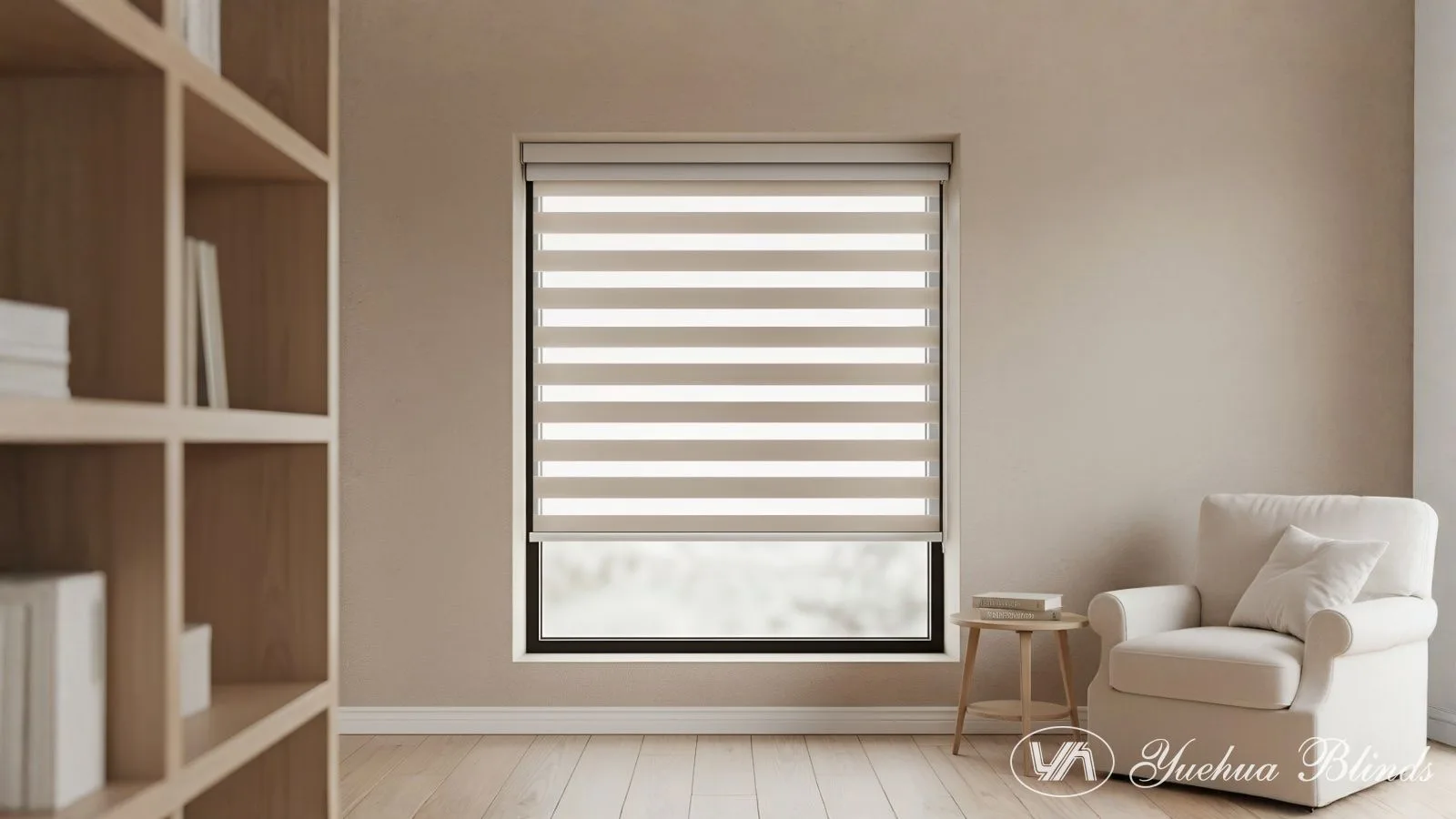
The standard pushes toward cordless designs, especially for children's rooms. Our cordless lines - the cordless zebra blinds are a practical example - remove the cords and with them most of the safety argument. For corded production, the safety device is fitted during manufacturing, not bolted on at the end.
Flame retardant requirements: not one EU rule, several local ones
There is no EU-wide mandatory flammability standard for window blinds. The obligations come from member states, and usually only when blinds go into public buildings:
- France: public buildings ask for M1-M4 ratings; residential sales are not covered.
- Germany: public buildings refer to DIN 4102 B1; residential is not mandatory.
- UK: public buildings commonly require BS 5867 Part 2 Type B; residential not mandatory.
If your channel is contract or project business in these countries, pre-testing fabrics to B1 or M1 level is worth doing at sourcing stage. Retro-fitting test reports after an order is a much slower conversation.
Labeling and packaging
- CE mark on the product where it applies.
- Fiber composition label under Regulation (EU) 1007/2011.
- Care label with washing and maintenance instructions.
- Instructions in the destination country's language - we print these per market.
Who does what: importer versus supplier
The common failure is assuming compliance is one side's problem. It is shared, and the division below is what we see work in practice.
Legal mandatory requirements
| Item | Responsibility | Scope | Notes |
| REACH restriction compliance | Supplier primary | All blinds | Azo dyes 30 mg/kg max, phthalates 0.1% max, heavy metal limits. Supplier ensures fabric compliance; importer verifies. |
| Cord safety devices | Supplier | All corded blinds | Tensioners or breakaway cleats fitted at production per EN 13120. |
| Child safety warnings | Supplier primary | All corded blinds | Text and pictograms on packaging and instructions. |
| EU Responsible Person | Importer | All products | GPSR mandatory since 13 December 2024. Entirely the importer's obligation. |
| CE marking | Importer | CE-required products | Importer affixes before EU market entry. |
| Declaration of Conformity | Importer | CE-required products | Importer signs and retains. Supplier provides test data. |
| RED + LVD | Supplier primary | Motorized only | Manual blinds completely exempt. |
Recommended (industry standard)
| Item | Responsibility | Notes |
| REACH SVHC test report | Supplier | Not legally mandated but needed to prove compliance. Update annually. |
| Azo, phthalate and heavy metal reports | Supplier | Proof of Annex XVII compliance. Usually issued by the fabric mill. |
| Technical file for 10 years | Importer primary | For CE products. Supplier keeps its own reports too. |
| Multilingual instructions | Supplier | Destination country language(s). |
Conditional (specific orders only)
| Item | Responsibility | Scenario |
| Flame retardant report | Supplier | Public building projects in France, Germany or the UK only. |
| CPR DoP | Importer | Construction component projects only. |
| Packaging law registration | Importer | Germany LUCID, France Triman - importer's obligation. |
| Motorized RED/LVD | Supplier | Motorized or remote-controlled blinds only. |
Bottom line
An EU-ready blind order comes down to a short checklist: the importer secures the GPSR Responsible Person and CE paperwork where it applies; the supplier proves REACH compliance, fits EN 13120 safety devices and labels correctly. Manual blinds skip RED; residential retail skips flame-retardant testing. Get those four facts straight and the rest is documentation.
For the REACH detail behind the limits above, see our chemical restriction guide. To see how EN 13120 compares with the US and Canadian rules, our cord safety standards comparison covers it. And if you are sourcing cordless to keep the compliance paperwork light, our cordless zebra blinds are a practical starting point.
Standards referenced in this guide were checked against current obligations in October 2026.